In 2021, 05 circuits were established in order to visit the inka city of Machupicchu. Through Ministerial Resolution 528-2023-MC, the Peruvian Ministry of Culture has modified these circuits. In that sense, since June 1, 2024, 03 new circuits (grouping 10 routes) have come into effect.
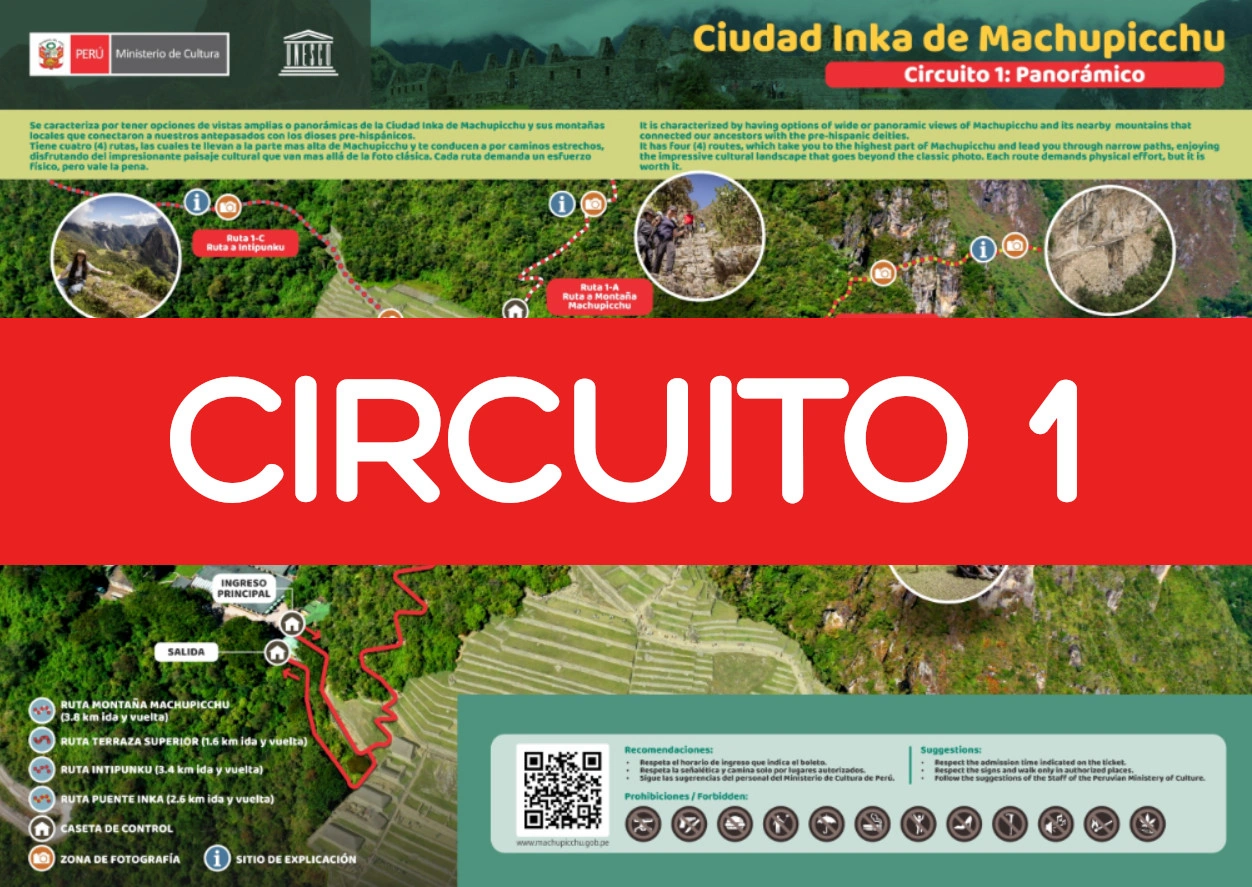
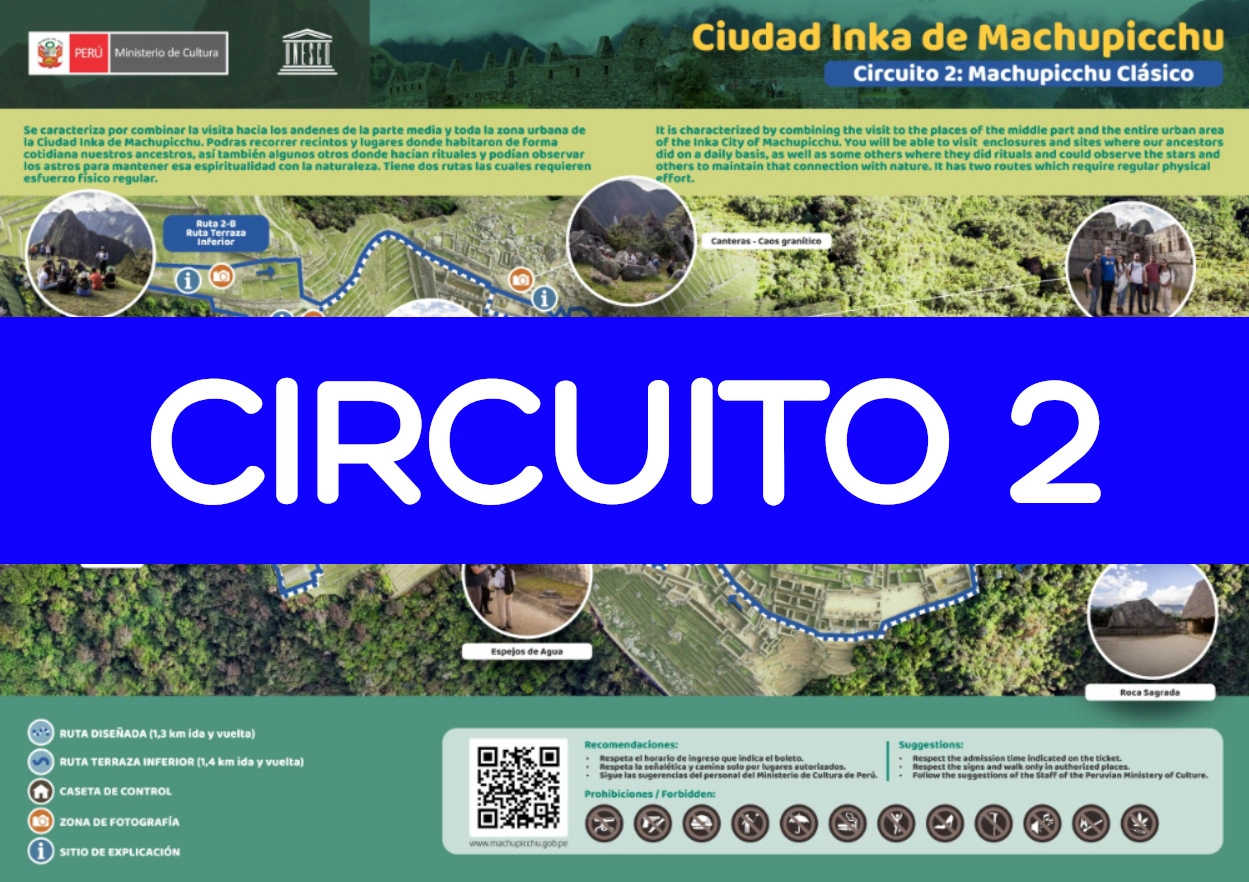
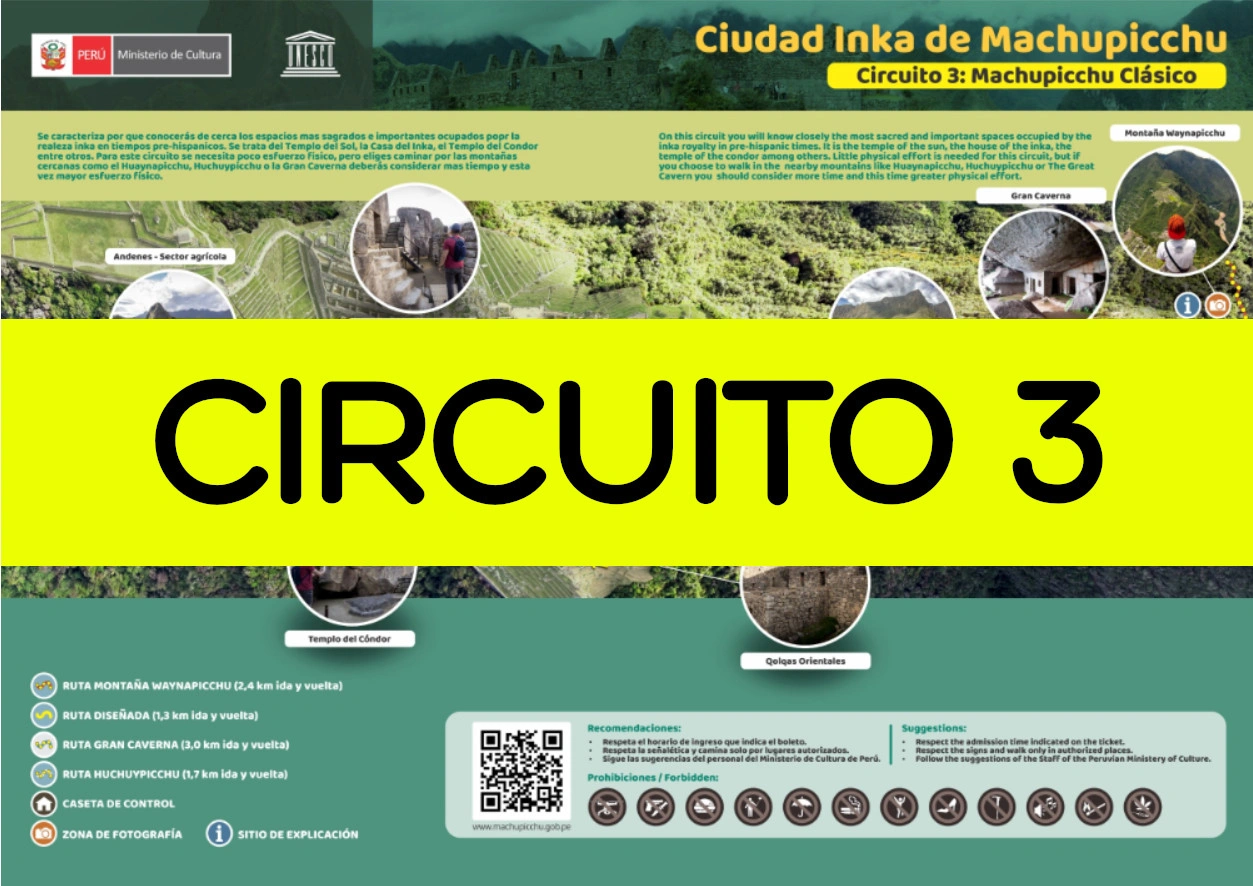
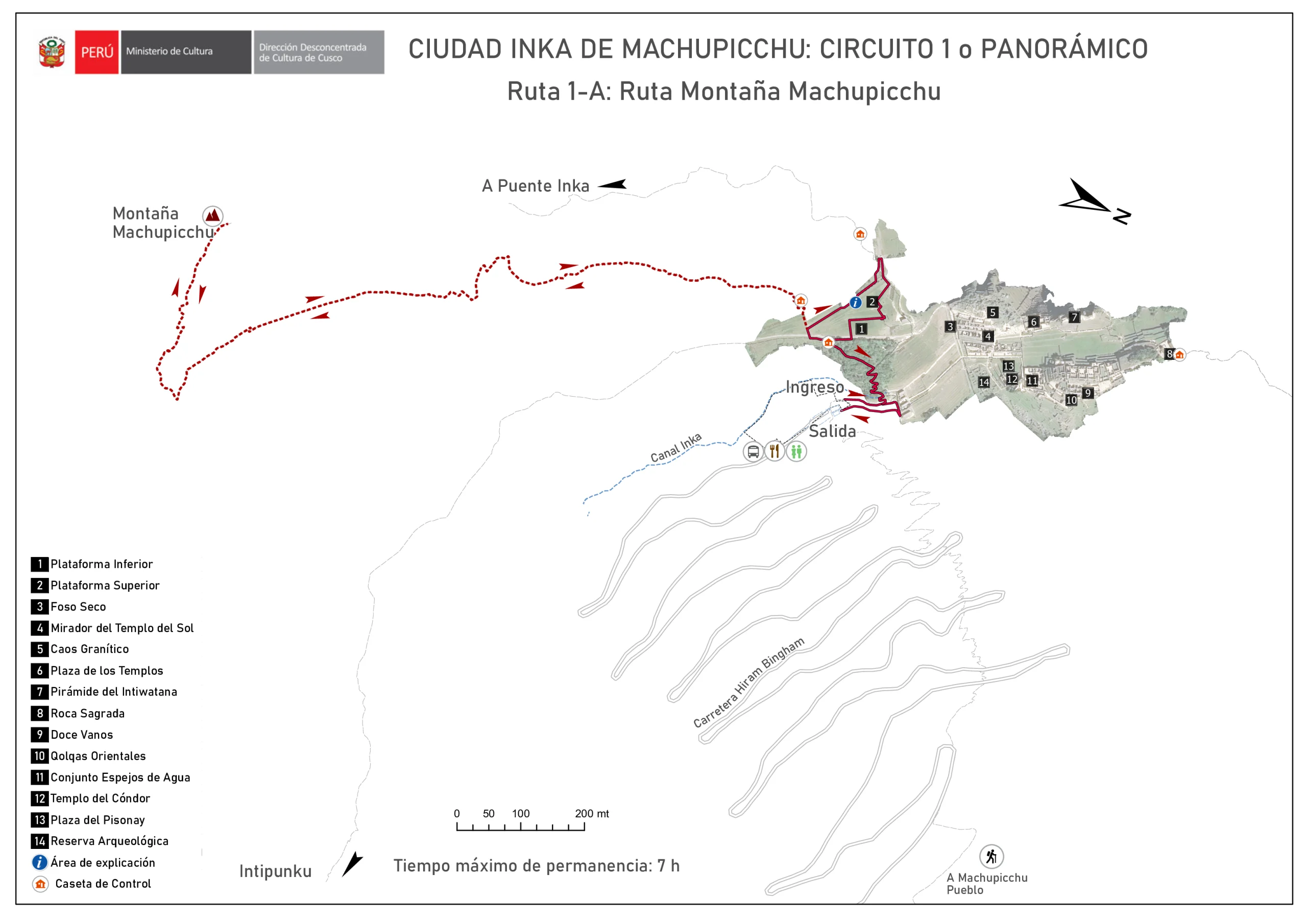
Circuit 1 (Panoramic) – Route 1-A: Machupicchu Mountain Route
Circuit 1 (Panoramic) – Route 1-A: Machupicchu Mountain Route is one of the tour options within the Historic Sanctuary of Machu Picchu. This route focuses on offering a panoramic experience and connection with nature, combining the exploration of the Inca citadel with a hike to Machupicchu Mountain, one of the elevations surrounding the archaeological site. Below, I will explain what it consists of:
Tour of the Inca Citadel:
- It begins with a tour of the main areas of Machu Picchu, where you can appreciate the agricultural, urban and religious sectors, such as the Temple of the Sun, the Main Square and the Guardian’s House.
- This circuit is less extensive than others, making it ideal for those looking for a shorter but equally impressive visit.
Ascent to Machupicchu Mountain:
- After exploring the citadel, the route continues with the ascent to Machupicchu Mountain, which is located at an altitude of approximately 3,082 meters above sea level.
- The trail is a well-marked path, but involves a moderate to intense physical effort, as it includes stone stairs and a considerable slope.
- The hike lasts between 2 to 3 hours (depending on the pace) and offers spectacular views of the citadel, the surrounding mountains and the Urubamba River valley.
Panoramic views:
- Once at the top, you will be rewarded with a unique panoramic view of Machu Picchu and the Andean landscape. It is an ideal place to take pictures and enjoy the immensity of the surroundings.
Duration and Requirements:
- The complete circuit (citadel + Machupicchu Mountain) can take between 4 to 6 hours, depending on the pace of each visitor.
- It is necessary to purchase a specific ticket that includes access to Machupicchu Mountain, since the entrance is regulated to control the number of visitors.
- It is recommended to bring water, snacks, sunscreen and appropriate footwear for walking.
In summary, this route is perfect for those who wish to combine archaeological exploration with a trekking experience and enjoy breathtaking views from an elevated perspective. However, it is important to be in good physical condition due to the effort involved in the ascent.
Map Route 1-A
Loop 1 (Panoramic) – Route 1-B: Upper Terrace Route
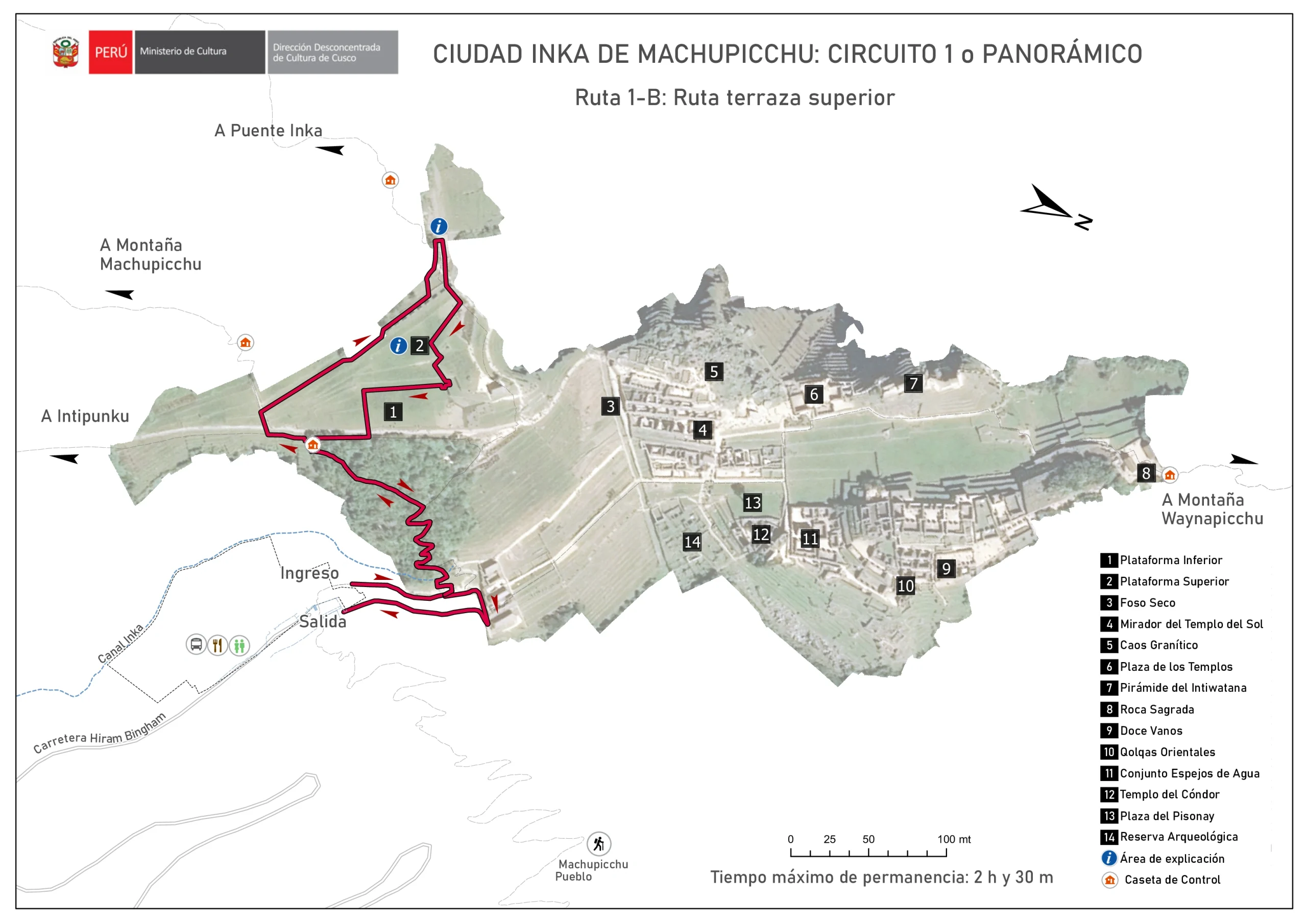
Circuit 1 (Panoramic) – Route 1-B: Upper Terrace Route is another tour option inside the Machu Picchu Historic Sanctuary. This circuit is designed for those who are looking for a shorter and less physically demanding experience, but still allows you to enjoy the panoramic views and the main attractions of the Inca citadel. Below, I detail what it consists of:
Characteristics of Loop 1 (Panoramic) – Route 1-B: Upper Terrace Route
Tour of the Inca Citadel:
- This circuit focuses on the most emblematic areas of Machu Picchu, but with a focus on the upper areas and agricultural terraces.
- It includes a visit to the upper terraces, from where there are impressive panoramic views of the citadel, the surrounding mountains and the Urubamba River valley.
- You will also visit sectors such as the Guardian’s House (from where the classic postcard photo of Machu Picchu is taken), the agricultural terraces and some urban areas.
Duration and Difficulty:
- This circuit is shorter and less physically demanding compared to other routes, such as Route 1-A (Machupicchu Mountain) or Route 2 (Classic).
- The tour lasts approximately 2 to 3 hours, depending on the visitor’s pace and the time spent taking pictures or admiring the scenery.
- It is ideal for people with reduced mobility, families with children or those who prefer a quieter tour.
Panoramic views:
- The Upper Terrace Route offers spectacular views of the citadel from elevated angles.
- It is an excellent option for those who want to capture memorable photographs without the need for long hikes or ascents.
Access and Requirements:
- To access this circuit, it is necessary to purchase the entrance ticket to Machu Picchu that includes Circuit 1.
- No additional permit is required, as in the case of Machupicchu Mountain or Huayna Picchu.
- It is recommended to bring water, sunscreen, a hat and comfortable shoes, as the terrain can be uneven in some areas.
Who is this route ideal for?
- Travelers with little time: If you have a tight itinerary, this route allows you to enjoy the highlights of Machu Picchu in a relatively short time.
- People with reduced mobility or limited physical condition: Being less demanding, it is accessible to a wide variety of visitors.
- Photography lovers: The panoramic views from the upper terraces are ideal for capturing incredible images.
In summary, Circuit 1 (Panoramic) – Route 1-B: Upper Terrace Route is an excellent option for those who wish to enjoy the most iconic views of Machu Picchu without making a significant physical effort. It is an accessible route and perfect for a first visit to the sanctuary.
Route Map 1-B
Circuit 1 (Panoramic) – Route 1-C: Portada Intipunku Route (available only in High Season)
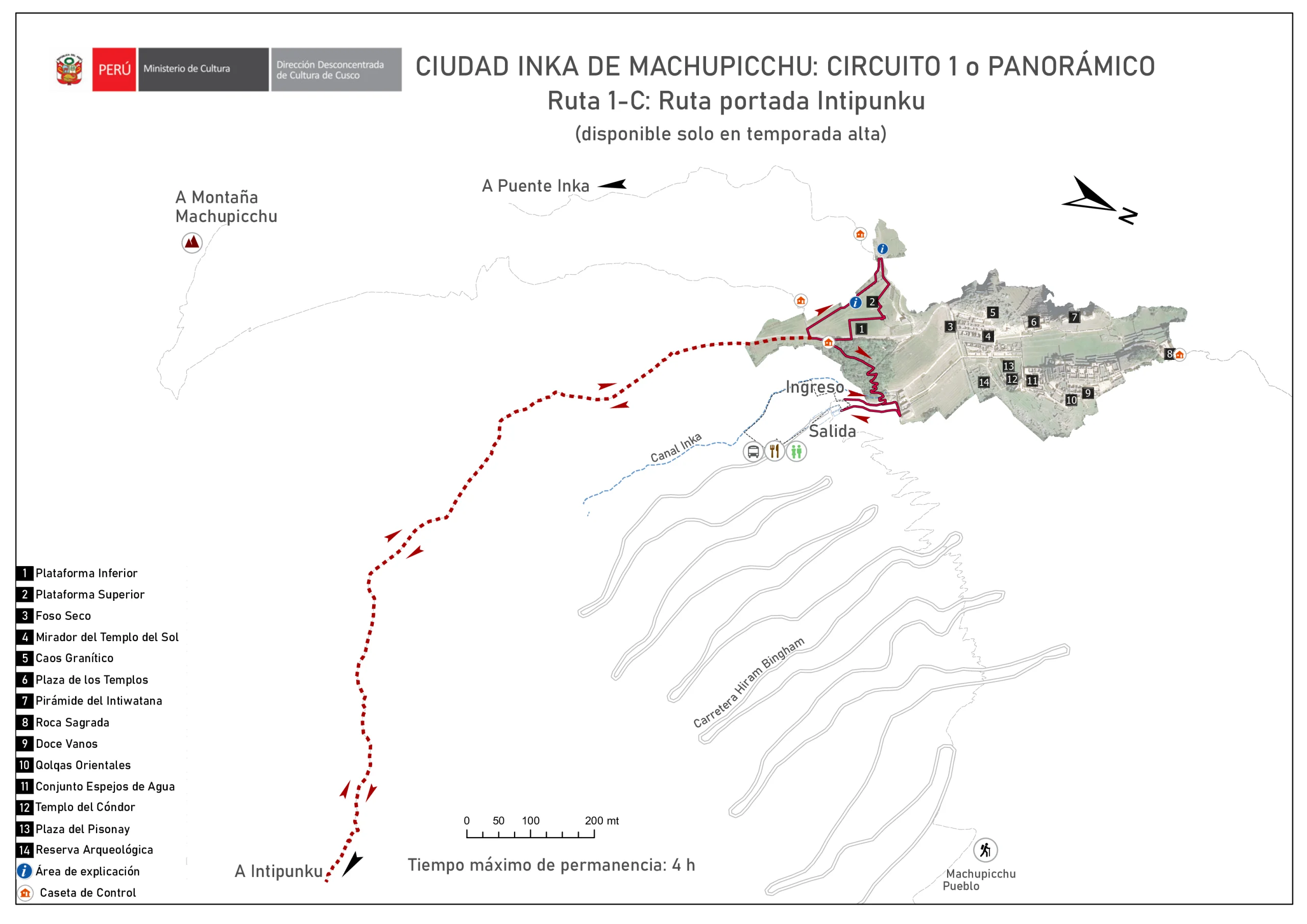
Circuit 1 (Panoramic) – Route 1-C: Intipunku Gateway Route is a tour option within the Machu Picchu Historic Sanctuary that is available only during the High Season (generally from April to October). This route combines the exploration of the Inca citadel with a hike to the Portada de Intipunku (also known as the Sun Gate), a historic and symbolic place that offers spectacular views of Machu Picchu and its surroundings. Below, I detail what this route consists of:
Characteristics of Circuit 1 (Panoramic) – Route 1-C: Portada Intipunku Route
Tour of the Inca Citadel:
- Like other routes of Circuit 1, this tour begins with a visit to the main areas of Machu Picchu, such as the agricultural terraces, the Guardian’s House (from where you get the classic panoramic view of the citadel) and some urban and religious sectors.
- This circuit is ideal for those who wish to have an overview of the citadel before starting the hike to Intipunku.
Hike to the Portada de Intipunku:
- The Portada de Intipunku (Sun Gate) is an archaeological site located at 2,720 meters above sea level, in the eastern part of Machu Picchu.
- This place was the main entry point to the citadel for travelers arriving on the Inca Trail. Historically, it was the first place from where Inca pilgrims and messengers could see Machu Picchu.
- The hike from the citadel to Intipunku takes approximately 1 to 1.5 hours (depending on the pace) and is of moderate difficulty, as it includes a climb up cobblestone paths and stairs.
- Along the way, you will enjoy breathtaking views of the Urubamba River valley and the surrounding mountains.
Panoramic views from Intipunku:
- Once at the Portada de Intipunku, you will be rewarded with a unique and privileged view of Machu Picchu from the top.
- This natural viewpoint is perfect for taking pictures and contemplating the majesty of the Inca citadel framed by the Andean landscape.
Duration and Requirements:
- The complete circuit (citadel + hike to Intipunku) can take between 3 to 4 hours, depending on the visitor’s pace.
- It is necessary to purchase an entrance ticket to Machu Picchu that includes Circuit 1. No additional permit is required, but it is important to book in advance, especially in high season.
- It is recommended to bring water, snacks, sunscreen, a hat and appropriate footwear for walking, as the terrain can be uneven and steep in some parts.
Who is this route ideal for?
- Hiking enthusiasts: If you enjoy hiking and want to combine archaeological exploration with an outdoor experience, this route is perfect for you.
- Travelers interested in history: The Portada de Intipunku has an important historical significance, as it was the ceremonial entry point to Machu Picchu.
- Photographers: The views from Intipunku are unique and offer a different perspective of the citadel.
Important to consider
- Availability: This route is only available during the High Season (April to October), when weather conditions are more favorable.
- Physical effort: Although it is not as demanding as the Machupicchu or Huayna Picchu Mountain Route, it does require a moderate level of physical condition due to the ascent.
- Schedule: It is advisable to start early in order to make the most of the experience and avoid the busiest times of the day.
In summary, Circuit 1 (Panoramic) – Route 1-C: Portada Intipunku Route is an excellent option for those who wish to combine the exploration of Machu Picchu with a historical and panoramic hike. It is a route that offers a unique perspective of the citadel and its surroundings, ideal for those seeking a more complete and enriching experience.
Route Map 1-C
Circuit 1 (Panoramic) – Route 1-D: Inka Bridge Route (only available in High Season)
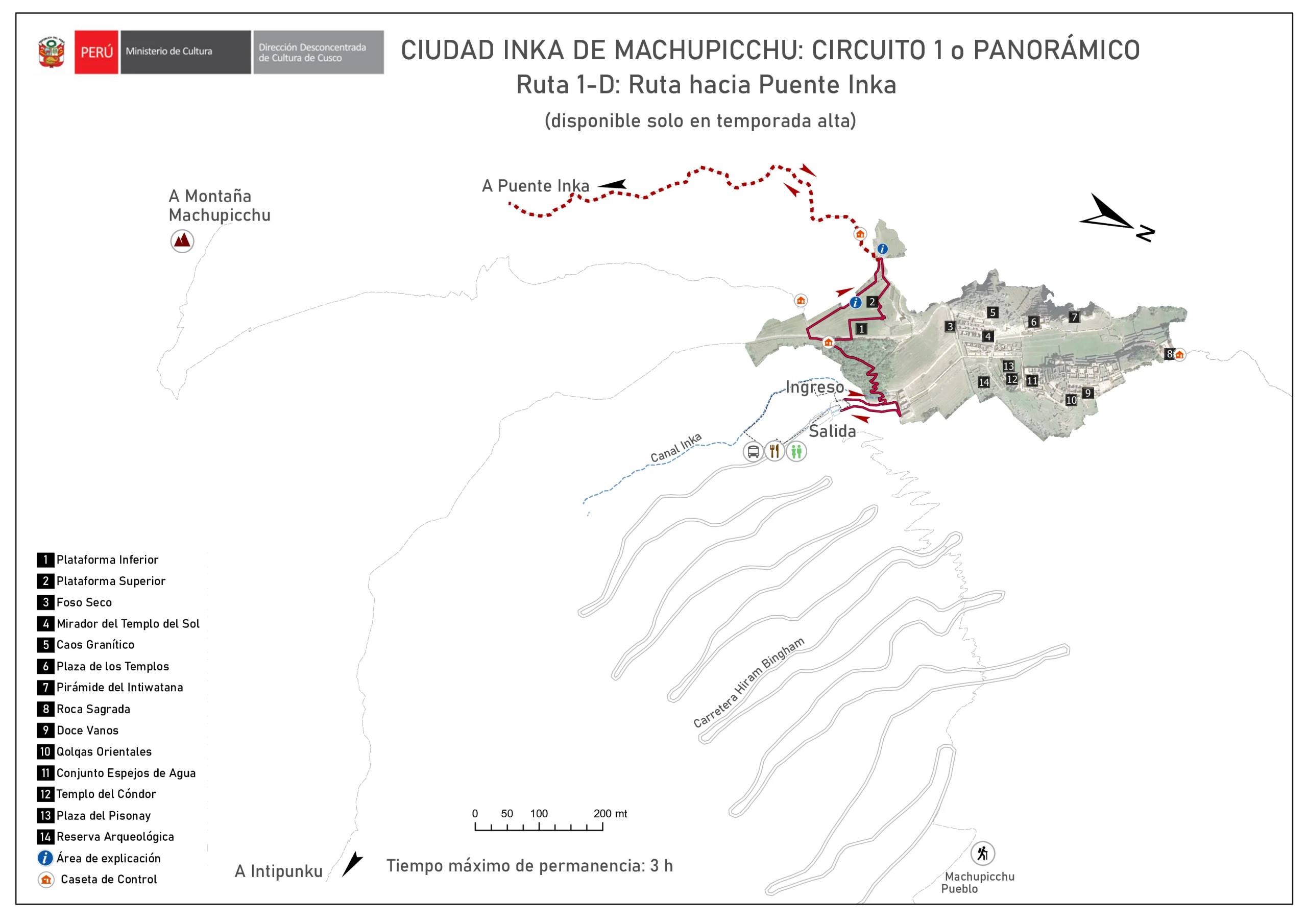
Circuit 1 (Panoramic) – Route 1-D: Inka Bridge Route is another tour option inside the Machu Picchu Historic Sanctuary, available only during the High Season (generally from April to October). This route combines the exploration of the Inca citadel with a hike to the Inca Bridge, an impressive Inca engineering structure that demonstrates the skill and dexterity of this civilization. Below, I detail what this route consists of:
Characteristics of Circuit 1 (Panoramic) – Route 1-D: Inka Bridge Route
Tour of the Inca Citadel:
- Like other routes of Circuit 1, this tour begins with a visit to the main areas of Machu Picchu, such as the agricultural terraces, the Guardian’s House (from where you get the classic panoramic view of the citadel) and some urban and religious sectors.
- This circuit is ideal for those who wish to have an overview of the citadel before starting the hike to the Inka Bridge.
Hike to the Inca Bridge:
- The Inca Bridge is a structure built by the Incas on a cliff, using advanced engineering techniques for the time. It is located at the western end of Machu Picchu, in an area surrounded by vegetation and with impressive views of the Urubamba River canyon.
- The hike from the citadel to the Inca Bridge takes approximately 1 to 1.5 hours (depending on the pace) and is of moderate difficulty. The trail is narrow in places and is bordered by cliffs, so caution is advised.
- During the journey, you will enjoy panoramic views of the mountainous landscape and tropical vegetation surrounding Machu Picchu.
The Inca Bridge:
- The bridge itself is a masterpiece of Inca engineering. It is built with stones and logs, and its main function was to serve as a strategic control point to protect the citadel from possible invaders.
- Although the bridge is not open for visitors to cross (for safety and conservation reasons), its location and design are impressive and offer a clear idea of Inca construction skill.
- This place is ideal for taking pictures and appreciating the integration of Inca architecture with the natural environment.
Duration and Requirements:
- The complete circuit (citadel + hike to the Inca Bridge) can take between 3 to 4 hours, depending on the visitor’s pace.
- It is necessary to purchase an entrance ticket to Machu Picchu that includes Circuit 1. No additional permit is required, but it is important to book in advance, especially in high season.
- It is recommended to bring water, snacks, sunscreen, a hat and appropriate footwear for walking, as the terrain can be uneven and steep in some parts.
Who is this route ideal for?
- History and engineering lovers: If you are interested in the architecture and construction techniques of the Incas, this route will allow you to appreciate one of their most impressive works.
- Travelers who enjoy nature: The hike to the Inca Bridge offers the opportunity to enjoy a lush natural environment and spectacular views.
- Photographers: The Inca Bridge and its surroundings are a perfect setting for capturing unique images.
Important to consider
- Availability: This route is only available during the High Season (April to October), when weather conditions are more favorable.
- Physical effort: Although it is not as demanding as the Machupicchu Mountain Route or Huayna Picchu, it does require a moderate level of physical fitness due to the uneven terrain and slopes.
- Safety: The trail to the Inca Bridge is narrow and close to cliffs, so caution is recommended, especially on rainy or foggy days.
In summary, Circuit 1 (Panoramic) – Route 1-D: Inka Bridge Route is an excellent option for those who wish to combine the exploration of Machu Picchu with a hike to one of the most fascinating and least known structures of the citadel. It is a route that offers a perfect blend of history, nature and adventure, ideal for those seeking a more complete and enriching experience.
Route Map 1-D
Circuit 2 (Classic Machupicchu) – Route 2-A: Designed route
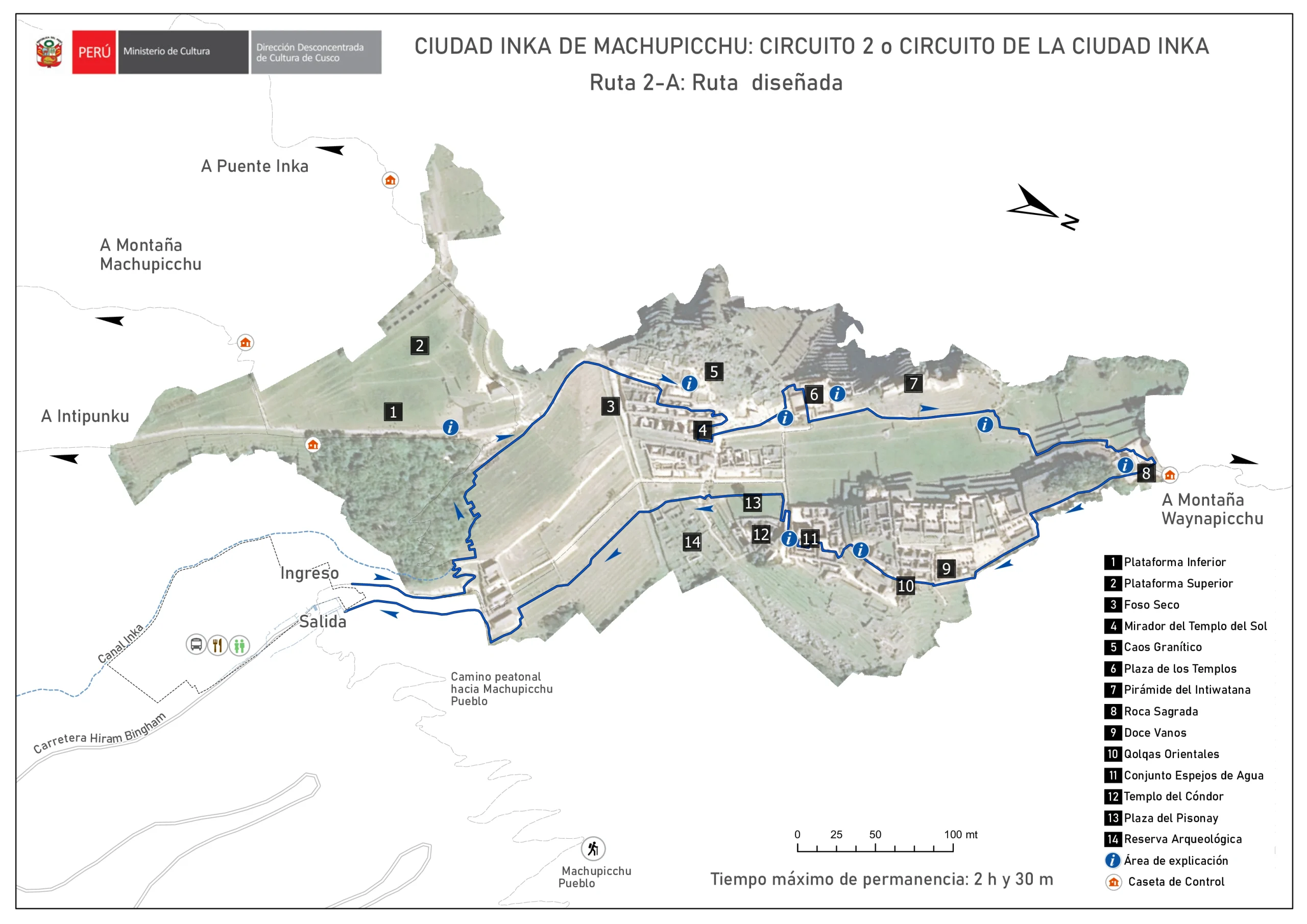
Circuit 2 (Classic Machupicchu) – Route 2-A: Designed route is one of the most popular and complete tours within the Historic Sanctuary of Machu Picchu. This circuit is designed to offer a classic and detailed experience of the Inca citadel, allowing visitors to explore the agricultural, urban and religious areas. Below, I detail what this route consists of:
Characteristics of Circuit 2 (Machupicchu Classic) – Route 2-A: Designed route
Tour of the Inca Citadel:
- This circuit is more extensive than Circuit 1 and covers most of the main areas of Machu Picchu, offering a complete view of the citadel.
- It includes a visit to the agricultural terraces, which demonstrate the ingenuity of the Incas to cultivate in mountainous terrain.
- The urban areas are also visited, where structures such as the Temple of the Sun, the Temple of the Three Windows, the Main Plaza and the Intihuatana (sundial) are found.
- In addition, the religious and ceremonial areas are explored, revealing the spiritual importance of Machu Picchu for the Incas.
Duration and Difficulty:
- This circuit lasts approximately 2.5 to 3.5 hours, depending on the visitor’s pace and the time spent exploring each area.
- It is of moderate difficulty, as it includes walking on cobblestone paths, going up and down stairs, and traversing uneven terrain. However, it is accessible to most visitors with basic fitness.
Main Sights and Attractions:
- Temple of the Sun: One of the most important structures, dedicated to the cult of the sun.
- Intihuatana: A carved stone that served as a sundial and astronomical marker.
- Temple of the Three Windows: A ceremonial building with impressive views.
- Main Plaza: The heart of the citadel, where social and ceremonial activities took place.
- Residential Zone: Where the inhabitants of Machu Picchu lived.
Access and Requirements:
- To access this circuit, it is necessary to purchase the entrance ticket to Machu Picchu that includes Circuit 2.
- No additional permit is required, but it is advisable to book in advance, especially in high season.
- It is recommended to bring water, sunscreen, a hat and comfortable shoes, as the tour involves walking for several hours.
Who is this route ideal for?
- First time visitors: If this is your first time in Machu Picchu, this route is ideal because it allows you to explore the main attractions of the citadel.
- History and archeology buffs: This circuit offers a detailed view of Inca architecture, engineering and spirituality.
- Photographers: The views from different points along the circuit are spectacular and offer unique opportunities to capture memorable images.
Important to consider
- Schedule: It is advisable to start early to avoid the busiest times of the day and enjoy a quieter experience.
- Guide: Hiring a guide can enrich the experience, as it will allow you to better understand the history and significance of each structure.
- Physical condition: Although it is not extremely demanding, it is important to be prepared to walk for several hours and face uneven terrain.
In summary, Circuit 2 (Classic Machupicchu) – Route 2-A: Designed route is the perfect option for those who wish to live a complete and detailed experience of Machu Picchu. It is a route that combines history, architecture and breathtaking scenery, ideal to immerse yourself in the magic of this wonder of the world.
Map of Route 2-A
Circuit 2 (Machupicchu Clásico) – Ruta 2-B: Ruta Terraza Inferior
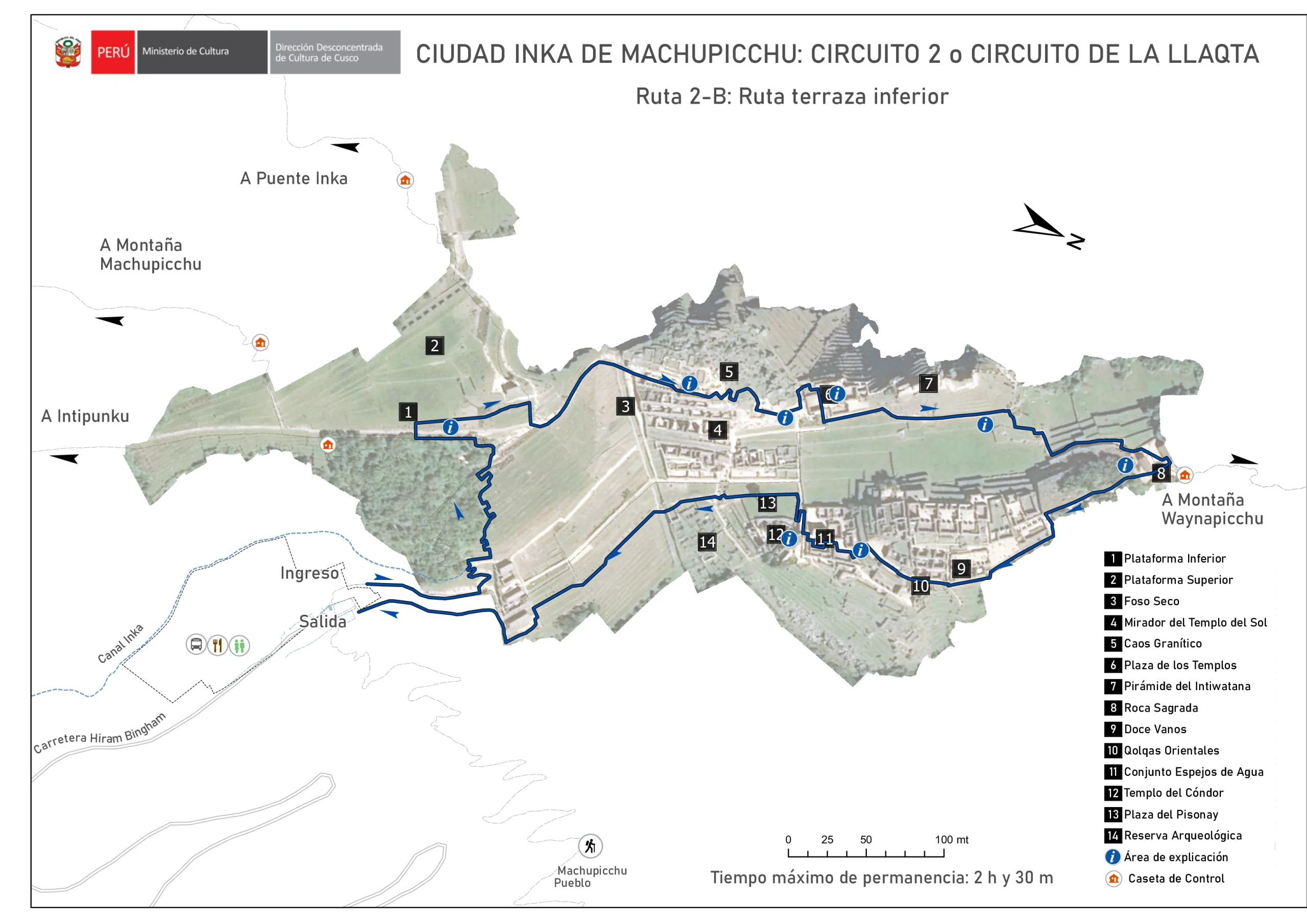
Circuit 2 (Classic Machupicchu) – Route 2-B: Lower Terrace Route is a variant of the classic tour inside the Machu Picchu Historic Sanctuary. This route is designed to offer a more focused experience in the lower areas of the citadel, including the lower terraces and some of the most important urban and ceremonial sectors. Below, I detail what this route consists of:
Characteristics of Circuit 2 (Machupicchu Classic) – Route 2-B: Lower Terrace Route
Tour of the Inca Citadel:
- This circuit focuses on the lower areas of Machu Picchu, including the lower agricultural terraces, which show the ingenuity of the Incas for cultivation in difficult terrain.
- It also takes in the urban and ceremonial areas, such as the Temple of the Sun, the Temple of the Three Windows, the Main Plaza and the Intihuatana (sundial).
- Unlike Route 2-A, this route does not cover some of the higher areas of the citadel, which makes it a little less extensive but equally fascinating.
Duration and Difficulty:
- This circuit lasts approximately 2 to 3 hours, depending on the visitor’s pace and the time spent exploring each area.
- It is of moderate difficulty, as it includes walking on cobblestone paths and going up and down stairs, but it is less demanding than other circuits that involve steeper ascents.
Main Sights and Attractions:
- Lower Agricultural Terraces: An impressive example of Inca agricultural engineering.
- Temple of the Sun: A ceremonial structure dedicated to the worship of the sun.
- Temple of the Three Windows: A building with impressive views and ceremonial significance.
- Main Plaza: The heart of the citadel, where social and ceremonial activities took place.
- Intihuatana: A carved stone that served as a sundial and astronomical marker.
Access and Requirements:
- To access this circuit, it is necessary to purchase the entrance ticket to Machu Picchu that includes Circuit 2.
- No additional permit is required, but it is advisable to book in advance, especially in high season.
- It is recommended to bring water, sunscreen, hat and comfortable shoes, since the tour involves walking for several hours.
Who is this route ideal for?
- First time visitors: If it is your first time in Machu Picchu, this route is ideal because it allows you to explore the main attractions of the citadel without being too demanding.
- People with reduced mobility or limited physical condition: Being less extensive and with fewer steep ascents, it is accessible to a wide variety of visitors.
- History and archeology lovers: This circuit offers a detailed view of Inca architecture, engineering and spirituality.
Important to consider
- Schedule: It is advisable to start early to avoid the busiest times of the day and enjoy a quieter experience.
- Guide: Hiring a guide can enrich the experience, as it will allow you to better understand the history and significance of each structure.
- Physical condition: Although it is not extremely demanding, it is important to be prepared to walk for several hours and face uneven terrain.
In summary, Circuit 2 (Classic Machupicchu) – Route 2-B: Lower Terrace Route is an excellent option for those who wish to enjoy a complete but less demanding experience in Machu Picchu. It is a route that combines history, architecture and breathtaking scenery, ideal to immerse yourself in the magic of this wonder of the world.
Map of Route 2-B
Circuit 3 (Machupicchu Realeza) – Ruta 3-A: Ruta Montaña Waynapicchu
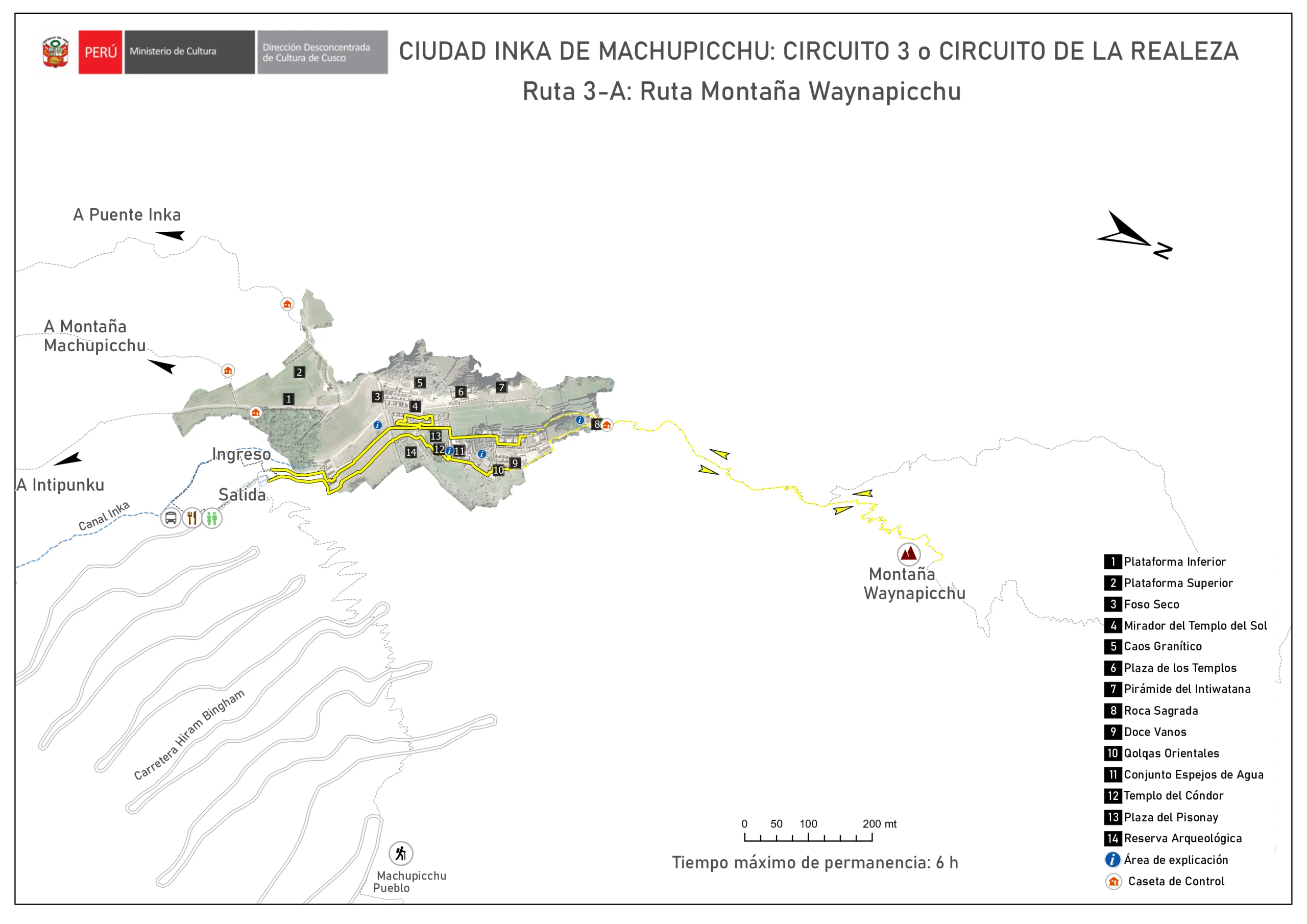
Circuit 3 (Machupicchu Royalty) – Route 3-A: Waynapicchu Mountain Route is one of the most emblematic and challenging treks within the Machu Picchu Historic Sanctuary. This route combines the exploration of the Inca citadel with the ascent of Waynapicchu Mountain (also known as Huayna Picchu), one of the iconic mountains that rise above Machu Picchu. Below, I detail what this route consists of:
Characteristics of Circuit 3 (Machupicchu Royalty) – Route 3-A: Waynapicchu Mountain Route
Tour of the Inca Citadel:
- The circuit begins with a visit to the main areas of Machu Picchu, including the agricultural terraces, the Guardian’s House (from where you get the classic panoramic view of the citadel) and some urban and ceremonial sectors.
- This initial tour allows us to appreciate the Inca architecture and engineering before starting the ascent to Waynapicchu.
Ascent to Waynapicchu Mountain:
- Waynapicchu Mountain is one of the most famous elevations of Machu Picchu, located at 2,693 meters above sea level.
- The ascent is challenging and takes approximately 1 to 1.5 hours (depending on the pace). The trail is narrow, steep and in some parts includes stone stairs carved into the rock.
- During the hike, you will enjoy spectacular views of the citadel, the Urubamba River and the surrounding mountains.
Cima de Waynapicchu:
- Once at the top, you will be rewarded with a breathtaking panoramic view of Machu Picchu and the entire valley. It is an ideal place to take pictures and contemplate the majesty of the landscape.
- At the top you will also find some Inca ruins, such as terraces and small structures, which demonstrate the ceremonial importance of this place.
Duration and Requirements:
- The complete circuit (citadel + Waynapicchu ascent) can take between 4 to 6 hours, depending on the visitor’s pace.
- It is necessary to purchase a specific ticket that includes access to Waynapicchu Mountain, since the entrance is regulated and only 400 visitors are allowed per day (divided into two groups: one that enters at 7:00 a.m. and another at 10:00 a.m.).
- It is recommended to bring water, snacks, sunscreen, a hat and appropriate footwear for walking, as the terrain is steep and slippery in some parts.
Who is this route ideal for?
- Hiking and adventure lovers: If you enjoy physical challenges and hiking at altitude, this route is perfect for you.
- Photographers: The views from the top of Waynapicchu are unique and offer an unparalleled perspective of Machu Picchu.
- Travelers interested in history and spirituality: Waynapicchu has an important ceremonial significance, as it is believed to have been a place of worship and astronomical observation.
Important to consider
- Physical difficulty: This route is demanding and is not recommended for people with vertigo, mobility problems or limited physical condition.
- Reservations: Due to the limited number of visitors, it is necessary to reserve well in advance, especially during the high season (April to October).
- Weather: The ascent can be more complicated on rainy or foggy days, so it is recommended to check the weather conditions before starting.
In summary, Circuit 3 (Machupicchu Royalty) – Route 3-A: Waynapicchu Mountain Route is a unique and challenging experience that combines the exploration of Machu Picchu with the ascent of one of its most iconic mountains. It is ideal for those seeking an unforgettable adventure and spectacular panoramic views, but requires good physical condition and adequate preparation.
Map of Route 3-A
Circuit 3 (Machupicchu Royalty) – Route 3-B: Designed route
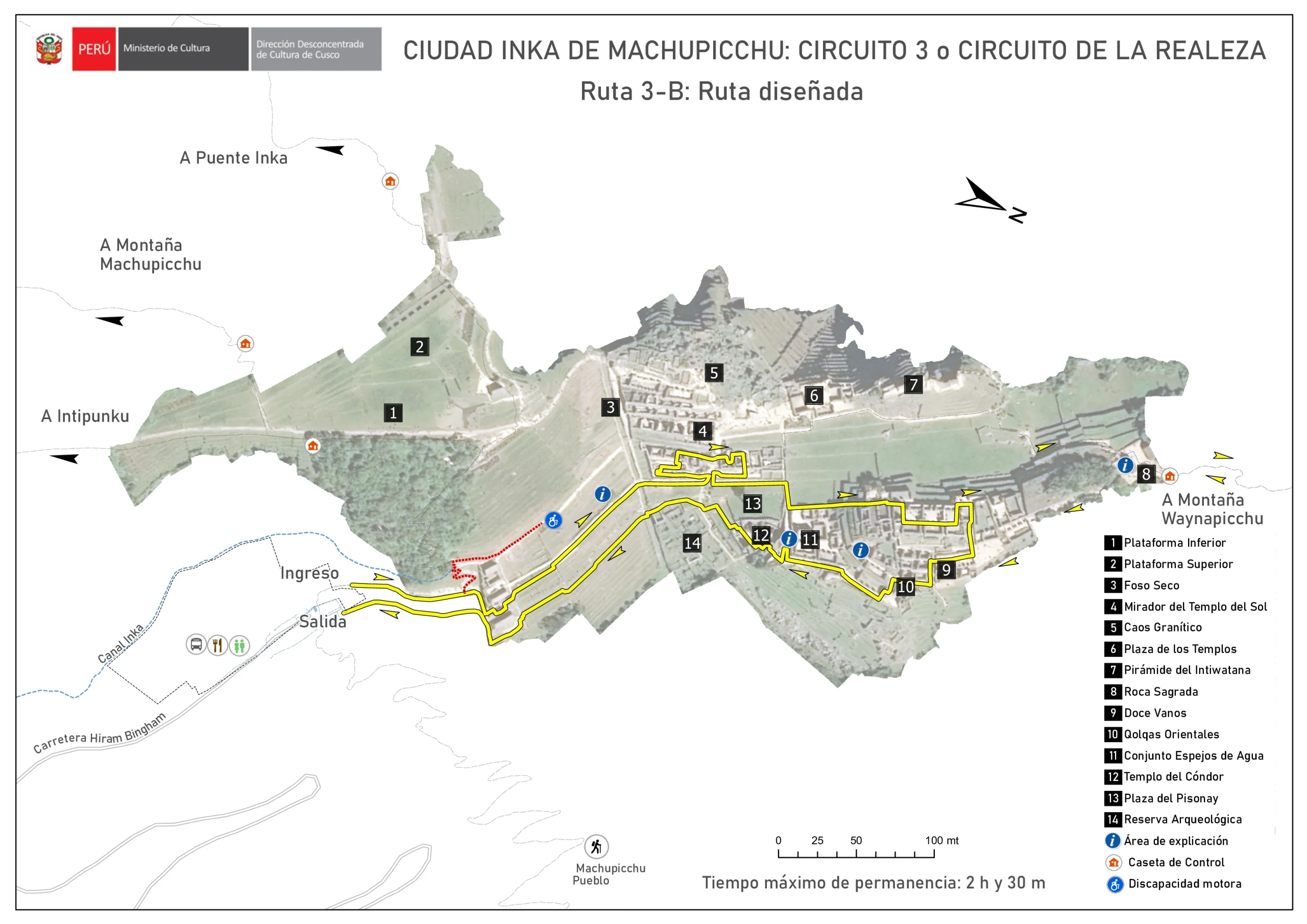
Circuito 3 (Machupicchu Royalty) – Rota 3-B: A Rota Desenhada é uma opção de passeio dentro do Santuário Histórico de Machu Picchu que foi projetada para oferecer uma experiência mais focada nas áreas cerimoniais e residenciais da cidadela, não incluindo a subida ao Monte Waynapicchu. Esta rota é ideal para aqueles que desejam explorar profundamente os setores mais importantes de Machu Picchu, mas preferem evitar o esforço físico adicional envolvido na escalada do Waynapicchu. Abaixo detalharei em que consiste esse roteiro:
Características do Circuito 3 (Machupicchu Royalty) – Rota 3-B: Rota projetada
Walk through the Inca Citadel:
- This tour focuses on the most emblematic and ceremonial areas of Machu Picchu, offering a detailed look at Inca architecture and spirituality.
- It includes a visit to the agricultural terraces, which show the ingenuity of the Incas in cultivating mountainous terrain.
- It also covers the urban and ceremonial areas, such as the Temple of the Sun, the Temple of the Three Windows, the Main Plaza, and the Intihuatana (sundial).
- It also explores the residential areas, where the inhabitants of Machu Picchu lived, and some lesser-known but equally fascinating structures.
Duration and Difficulty:
- This tour lasts approximately 2.5 to 3.5 hours, depending on the visitor’s pace and the time spent exploring each area.
- It is of moderate difficulty, as it includes walking on cobblestone paths, going up and down stairs, and traversing uneven terrain. However, it is accessible to most visitors with a basic physical condition.
Main Sights and Attractions:
- Temple of the Sun: One of the most important structures, dedicated to the worship of the sun.
- Intihuatana: A carved stone that served as a sundial and astronomical marker.
- Temple of the Three Windows: A ceremonial building with impressive views.
- Main Plaza: The heart of the citadel, where social and ceremonial activities took place.
- Residential Zone: Where the inhabitants of Machu Picchu lived.
Access and Requirements:
- To access this circuit, it is necessary to purchase the entrance ticket to Machu Picchu that includes Circuit 3.
- No additional permit is required, but it is advisable to book in advance, especially during High Season.
- It is recommended to bring water, sunscreen, a hat and comfortable shoes, since the tour involves walking for several hours.
Who is this route ideal for?
- First-time visitors: If it’s your first time at Machu Picchu, this route is ideal because it allows you to explore the citadel’s main attractions without being too demanding.
- History and archaeology lovers: This circuit offers a detailed look at Inca architecture, engineering, and spirituality.
- Photographers: The views from different points of the circuit are spectacular and offer unique opportunities to capture memorable images.
Important to consider
- Schedule: It is advisable to start early to avoid the busiest hours and enjoy a more peaceful experience.
- Guide: Hiring a guide can enrich the experience, as it will allow you to better understand the history and meaning of each structure.
- Physical condition: Although it is not extremely demanding, it is important to be prepared to walk for several hours and face uneven terrain.
In summary, Circuit 3 (Machupicchu Royalty) – Route 3-B: Designed Route is an excellent option for those who wish to enjoy a complete and detailed experience of Machu Picchu without the additional effort of climbing Waynapicchu Mountain. It is a route that combines history, architecture and impressive landscapes, ideal for immersing yourself in the magic of this wonder of the world.
Route Map 3-B
Circuit 3 (Machupicchu Royalty) – Route 3-C: Great Cavern Route (available only in High Season)
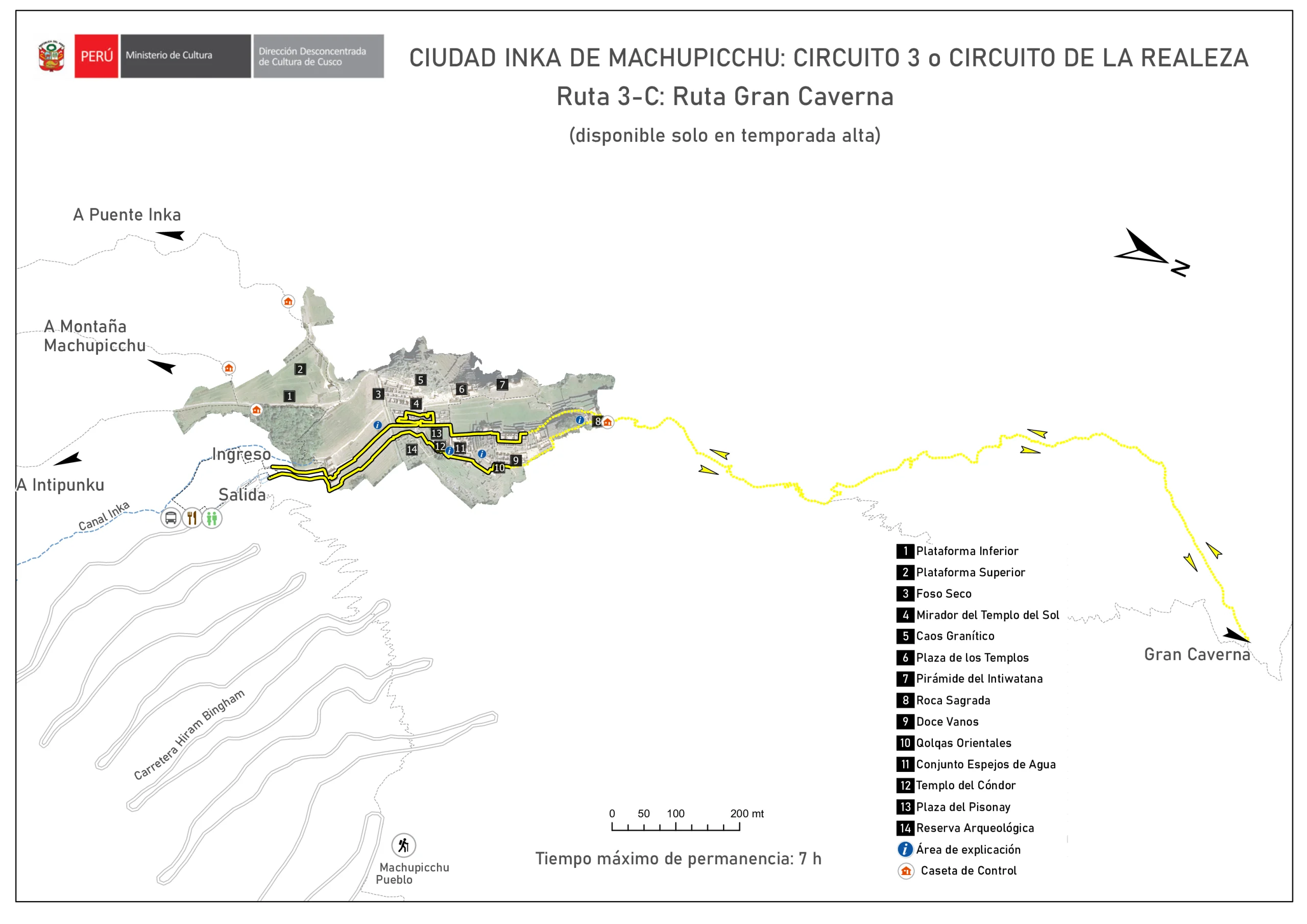
Circuit 3 (Machu Picchu Royalty) – Route 3-C: Great Cavern Route is a tour option within the Historic Sanctuary of Machu Picchu that is available only during High Season (usually April through October). This route combines exploration of the Inca citadel with a hike to the Great Cavern, a lesser-known but fascinating archaeological site located on the slopes of the mountain. Below is a breakdown of what this route entails:
Features of Circuit 3 (Machupicchu Royalty) – Route 3-C: Great Cavern Route
Tour of the Inca Citadel:
- Like other routes in Circuit 3, this tour begins with a visit to the main areas of Machu Picchu, including the agricultural terraces, the Guardian’s House (from where you get the classic panoramic view of the citadel) and some urban and ceremonial sectors.
- This circuit is ideal for those who want to have an overview of the citadel before embarking on the hike to the Great Cavern.
Hike to the Great Cavern:
- The Great Cave is an archaeological site located on the slopes of the mountain, at an altitude of approximately 2,600 meters above sea level.
- The hike from the citadel to the Great Cave takes approximately 1.5 to 2 hours (depending on the pace) and is of moderate difficulty. The trail is narrow in some parts and is surrounded by tropical vegetation.
- During the journey, you can enjoy spectacular views of the Urubamba River valley and the surrounding mountains.
The Great Cavern:
- The Great Cave is a natural formation that was used by the Incas for ceremonial purposes. It is believed that this place had an important spiritual meaning, possibly related to rituals of worship of the earth and the mountains.
- Inside the cave, you can see remains of Inca constructions, such as walls and niches, which demonstrate the adaptation of this civilization to the natural environment.
- This place is ideal for taking photographs and appreciating the integration of Inca architecture with the landscape.
Duration and Requirements:
- The full circuit (citadel + hike to the Great Cavern) can take between 4 to 5 hours, depending on the visitor’s pace.
- It is necessary to purchase an entrance ticket to Machu Picchu that includes Circuit 3. No additional permit is required, but it is important to book in advance, especially during High Season.
- It is recommended to bring water, snacks, sunscreen, a hat and suitable walking shoes, as the terrain can be uneven and slippery in some parts.
Who is this route ideal for?
- Adventure and exploration lovers: If you enjoy hiking and want to discover lesser-known places, this route is perfect for you.
- Travelers interested in Incan spirituality: The Great Cave has an important ceremonial significance, making it a fascinating place for those looking to connect with Incan culture.
- Photographers: The views from the trail and the Great Cave itself offer unique opportunities to capture stunning images.
Important to consider
- Availability: This route is only available during the High Season (April to October), when weather conditions are more favorable.
- Physical effort: Although not as demanding as the Waynapicchu Mountain Route, it does require a moderate level of fitness due to the uneven terrain and slopes.
- Safety: The trail to the Great Cavern is narrow and can be slippery on rainy days, so caution is recommended.
In short, Circuit 3 (Machupicchu Royalty) – Route 3-C: Great Cavern Route is an excellent option for those who wish to combine the exploration of Machu Picchu with a hike to a lesser-known but equally fascinating archaeological site. It is a route that offers a perfect mix of history, nature and adventure, ideal for those looking for a more complete and enriching experience.
Route Map Route 3-C
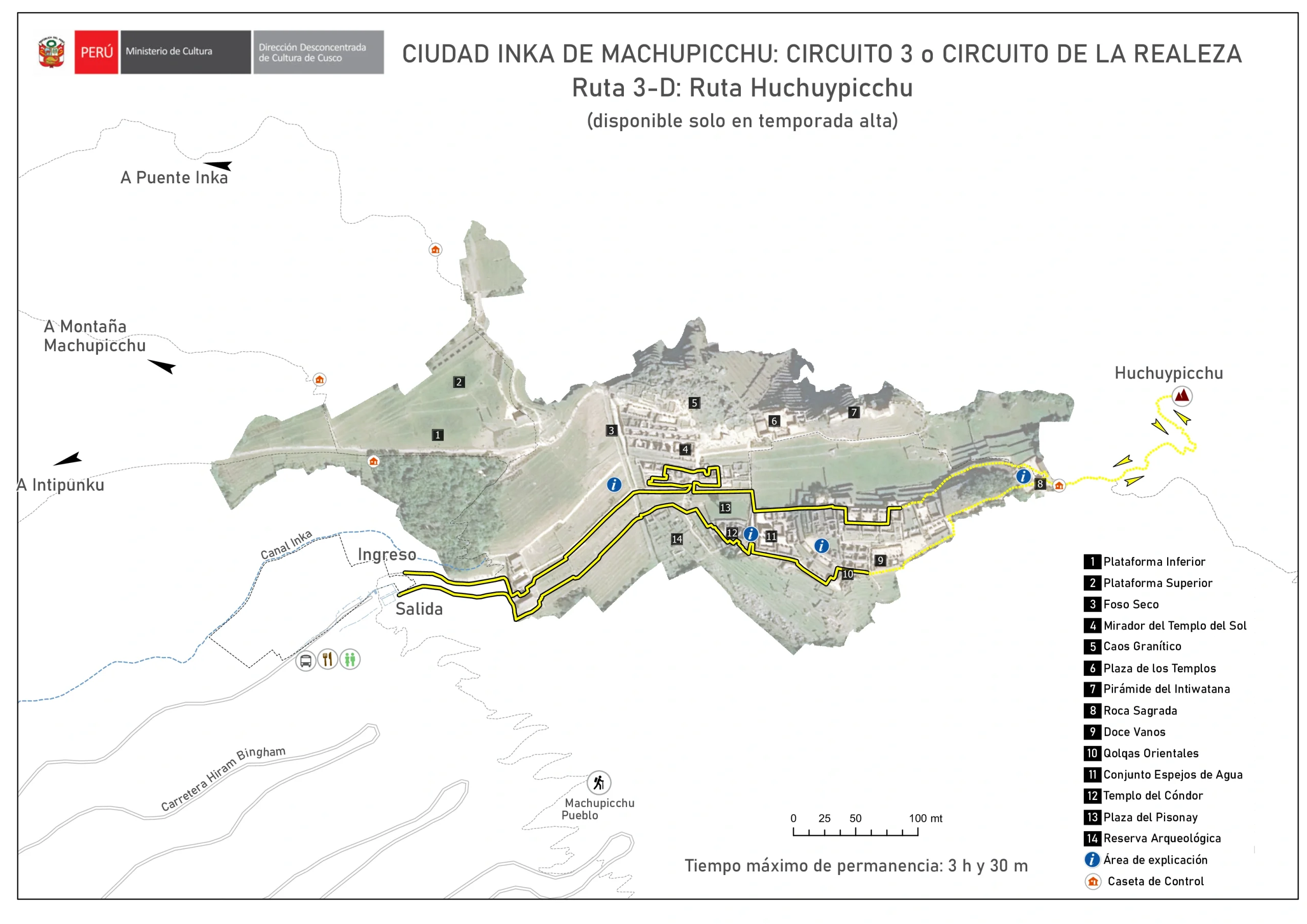
Circuit 3 (Machu Picchu Royalty) – Route 3-DE: Huchuypicchu Route (available only in High Season)
Circuit 3 (Machupicchu Royalty) – 3-D Route: Huchuypicchu Route is a tour option within the Historic Sanctuary of Machu Picchu that is available only during High Season (usually April through October). This route combines exploration of the Inca citadel with a hike to Huchuypicchu, a smaller and lesser-known mountain than Waynapicchu Mountain, but one that offers spectacular views and a unique experience. Below I will detail what this route consists of:
Characteristics of Circuit 3 (Machu Picchu Royalty) – Route 3-DE: Huchuypicchu Route
Tour of the Inca Citadel:
- Like other routes in Circuit 3, this tour begins with a visit to the main areas of Machu Picchu, including the agricultural terraces, the Guardian’s House (from where you get the classic panoramic view of the citadel) and some urban and ceremonial sectors.
- This circuit is ideal for those who want to have an overview of the citadel before embarking on the hike to Huchuypicchu.
Hike to Huchuypicchu:
- Huchuypicchu (also known as “Young Mountain” or “Little Mountain”) is an elevation located about 2,497 meters above sea level, near Waynapicchu Mountain.
- The hike from the citadel to the top of Huchuypicchu takes approximately 1 to 1.5 hours (depending on pace) and is of moderate difficulty. The trail is narrow and includes stone stairs in some parts, but is less demanding than the ascent to Waynapicchu.
- Along the way, you can enjoy panoramic views of Machu Picchu, the Urubamba River, and the surrounding mountains.
Summit of Huchuypicchu:
- Once at the top, you’ll be rewarded with a stunning view of Machu Picchu and the Andean landscape. Although less elevated than Waynapicchu, Huchuypicchu offers a unique and less crowded perspective.
- At the top are also some Inca ruins, such as terraces and small structures, which demonstrate the ceremonial importance of this place.
Duration and Requirements:
- The complete circuit (citadel + hike to Huchuypicchu) can take between 3 to 4 hours, depending on the visitor’s pace.
- It is necessary to purchase a specific ticket that includes access to Huchuypicchu, since entry is regulated and only 200 visitors are allowed per day.
- It is recommended to bring water, snacks, sunscreen, a hat and suitable walking shoes, since the terrain is steep and slippery in some parts.
Who is this route ideal for?
- Hiking and adventure lovers: If you enjoy hiking but prefer a less demanding route than Waynapicchu, Huchuypicchu is an excellent option.
- Photographers: The views from the top of Huchuypicchu are unique and offer a different perspective of Machu Picchu.
- Travelers interested in history and spirituality: Huchuypicchu has an important ceremonial meaning, as it is believed to have been a place of worship and astronomical observation.
Important to consider
- Availability: This route is only available during the High Season (April to October), when weather conditions are more favorable.
- Reservations: Due to limited visitors, reservations are required well in advance, especially during High Season.
- Physical Effort: Although less demanding than Waynapicchu, this route requires a moderate level of fitness due to the uneven terrain and slopes.
- Safety: The trail is narrow and can be slippery on rainy days, so caution is advised.
In summary, Circuit 3 (Machupicchu Royalty) – 3-D Route: Huchuypicchu Route is an excellent option for those who wish to combine the exploration of Machu Picchu with a hike to a lesser-known but equally fascinating mountain. It is a route that offers a perfect mix of history, nature and adventure, ideal for those looking for a calmer and more enriching experience.
3-D Route Map