 ,
,
 and
and

 Promo Codes Available:
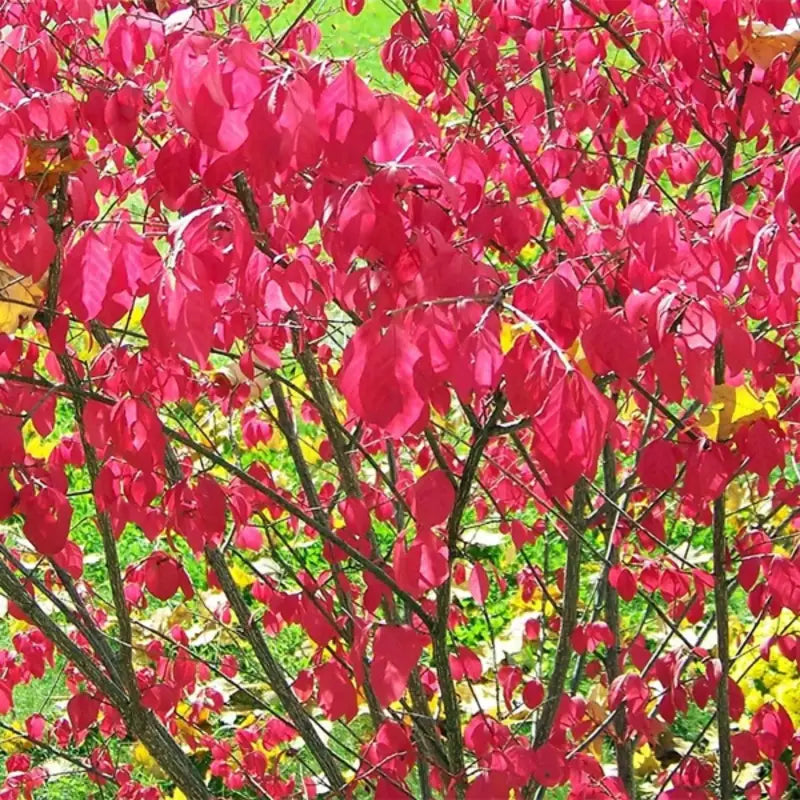
Burning bush (Euonymus alatus) is famous for its brilliant scarlet fall color—among the most vivid of any deciduous shrub.
Grow Your Own Burning Bush Seeds (Euonymus alatus) – Brilliant Fiery-Red Fall Foliage Shrub for Dramatic Hedges, Foundation Plantings & Wildlife Habitat Nationwide
Burning Bush (Euonymus alatus), also known as Winged Euonymus, is a deciduous shrub famous for its spectacular, flame-red fall foliage that turns landscapes into a fiery show each autumn. It features distinctive corky “wings” on its stems and produces small red berries that provide winter food for birds. It grows 4–8 ft tall and wide, making it a popular choice for hedges, borders, foundation plantings, and mass plantings where quick, low-maintenance color is desired.
Important Note on Invasiveness: Burning Bush is listed as invasive or potentially invasive in many U.S. states (especially in the Northeast, Midwest, and parts of the Mid-Atlantic and South). It spreads aggressively by bird-dispersed seeds and can outcompete native plants. Many states discourage or restrict its planting. This seed is best suited for contained landscapes, large rural properties, or areas where invasiveness is not a local concern. Always check your state’s invasive species list or consult your local extension office before planting. Consider native alternatives for responsible landscaping.
Ideal for homeowners seeking bold seasonal color, windbreak screens, or low-maintenance shrubs in tough soils.
Step-by-Step Growing Guide (Seed to Young Shrub in 1–2 Years)
1. Seed Prep & Stratification
Winged samaras require cold moist stratification. Mix seeds with damp sand or peat moss, seal in a bag, and refrigerate at 34–40°F for 90–120 days. Start stratification in late fall/winter for spring sowing.
• Nationwide timing tip: Stratify over winter. Chicago/Midwest/Northeast: December–February.
2. Sowing
After stratification, surface sow or plant ¼–½ inch deep in deep pots or seed beds with well-draining soil. Germinates in spring at 60–70°F (often irregular). Keep consistently moist.
3. Early Care & Container Growth
Grow seedlings in deep pots for 1–2 years to develop strong roots. Provide full sun to partial shade. Protect from deer and rodents. Light balanced fertilizer once established.
4. Planting Out & Site Selection
Full sun to partial shade. Space 4–6 ft apart for hedges or screens. Adaptable to a wide range of soils (including clay and poor conditions). Water deeply the first 2–3 years.
5. Long-Term Growth & Maintenance
Moderate to fast grower. Prune in late winter/early spring for shape. Fall color peaks in October–November. Monitor for scale insects or powdery mildew in humid areas.
Pro Tip for Every State: Grow in large containers for the first 1–2 years if you want to control spread or move the plant easily. Excellent for difficult or disturbed sites where quick establishment is needed.
Burning Bush Seeds (Euonymus alatus) – Detailed 50-State Sowing Calendar (2026)
Burning Bush seeds (winged samaras) require cold moist stratification for reliable germination. This hardy deciduous shrub (USDA zones 3–8/9) is prized for its brilliant fiery-red fall color but is listed as invasive or potentially invasive in many states (especially Northeast, Midwest, and parts of the South). It self-seeds readily and can outcompete native plants. Always check your state’s invasive species list or consult your local extension office before planting. Consider native alternatives for responsible landscaping.
Key rules that apply to every state:
- Cold moist stratification required: Mix samaras with damp sand or peat moss, seal in a bag, and refrigerate at 34–40°F for 90–120 days.
- Start stratification in late fall/winter so seeds are ready for spring sowing.
- After stratification, surface sow or plant ¼–½ inch deep in deep pots or seed beds with well-draining soil. Germination can be irregular (some seeds sprout year 1, others year 2).
- Grow seedlings in deep containers for 1–2 years before transplanting outdoors.
- Final planting: full sun to partial shade, 4–6 ft spacing for hedges/screens.
Detailed 50-State Sowing Calendar (Grouped by Region for Easy Reading)
Dates are averages based on 50% probability last spring frost and typical 2026 conditions. Adjust ±7–14 days for your exact microclimate or elevation.
|
Region / States |
Start Stratification |
Sow After Stratification (indoors or seed beds) |
Transplant Saplings Outdoors |
Notes / Example Cities |
|
Northeast (ME, NH, VT, MA, RI, CT, NY, PA, NJ) |
Nov 15 – Jan 1 |
March 15 – April 20 |
April 25 – June 1 |
New York City: Stratify mid Dec → Sow early April → Transplant mid May |
|
Midwest & Great Lakes (IL, IN, OH, MI, WI, MN, IA, MO, ND, SD, NE, KS) |
Dec 1 – Jan 15 |
March 20 – April 25 |
May 1 – June 10 |
Chicago, IL: Stratify mid Dec → Sow early April → Transplant mid to late May |
|
Mid-Atlantic & Upper South (DE, MD, DC, VA, WV, KY, NC, TN) |
Nov 20 – Jan 5 |
March 10 – April 15 |
April 20 – May 25 |
Washington DC: Stratify early Dec → Sow mid March → Transplant late April |
|
Southeast & Gulf (SC, GA, AL, MS, AR, LA, OK) |
Nov 1 – Dec 20 |
Feb 25 – April 5 |
March 25 – May 15 |
Atlanta: Stratify mid Nov → Sow early March → Transplant mid April |
|
Texas |
North: Nov 15 – Dec 20 Central/South: Oct 20 – Dec 5 |
North: March 1–April 1 Central/South: Feb 15–March 20 |
North: April–May Central/South: March–April |
Dallas: Stratify late Nov → Sow mid March → Transplant mid April Houston: Earlier fall stratification recommended |
|
Florida |
Oct 15 – Dec 1 |
Feb 1 – March 15 |
March 1 – April 15 |
Miami: Stratify late Oct → Sow mid Feb → Transplant early March |
|
Southwest (AZ, NM, UT, NV) |
Nov 15 – Jan 10 |
March 15 – April 20 |
April 20 – May 20 |
Phoenix: Stratify Dec → Sow early April → Transplant mid April |
|
Mountain & Northern West (CO, ID, MT, WY) |
Dec 1 – Feb 1 |
April 1 – May 1 |
May 10 – June 15 |
Denver: Stratify mid Dec → Sow early April → Transplant late May |
|
Pacific Northwest (WA, OR) |
Dec 1 – Jan 20 |
March 20 – April 25 |
April 25 – June 1 |
Seattle: Stratify mid Dec → Sow early April → Transplant mid May |
|
California |
Northern/Coastal: Nov 15 – Jan 5 Southern/Inland: Nov 1 – Dec 15 |
March 1 – April 15 |
March 20 – May 15 |
Los Angeles: Stratify mid Nov → Sow mid March → Transplant early April San Francisco: Similar to PNW timing |
|
Alaska |
Jan 1 – Feb 20 |
April 20 – May 20 |
May 25 – June 30 |
Anchorage: Short season — stratify early Jan → Sow mid April → Transplant late May (container start recommended) |
|
Hawaii |
Limited use (mild winters) |
Feb – March (or direct fall sowing) |
March – April |
Honolulu: Higher elevations only; invasiveness concerns apply |
Pro Tips for Every State
- Chicago / Midwest / Northeast gardeners: Start stratification in mid-December and sow indoors or in a cold frame in early spring. Grow in deep pots the first 1–2 years for strong root systems.
- Southern gardeners: Earlier stratification (October–November) works best; consider fall direct sowing where permitted.
- Container / balcony growers: Not ideal long-term (shrubs get large), but perfect for the first 1–2 years of seedling growth before permanent planting.
- Invasiveness awareness: In many states, Burning Bush is discouraged near natural areas. Monitor for self-seeding and consider native alternatives (e.g., Red Chokeberry or Sumac) for similar fall color without ecological risk.
🌳🍁
Key Benefits
- Brilliant scarlet fall foliage
- Dense, rounded form
- Easy to grow and maintain
- Excellent for hedges or specimens
- Check invasive status in your area
How to Grow
- Cold stratify 90–120 days
- Sow 1/4 inch deep in spring
- Germination may be slow and irregular
- Transplant when 6+ inches tall
- Space 6–8 feet apart for hedges
Specifications
Variety: Burning Bush (Euonymus alatus). Height: 8–12 ft. Spread: 8–12 ft. Fall color: Scarlet-crimson. Hardiness: Zones 4–8. Sun: Full sun to part shade.
Care & Storage
Store seeds refrigerated. Pruning shapes easily. Remove suckers if spread is unwanted.
Key Terms
- Euonymus alatus — Burning Bush; winged euonymus
- Invasive species — Plants that spread aggressively outside native range
- Fall color — Seasonal leaf color change
Important Notice
- Residents where burning bush is prohibited
- Gardeners near natural areas
- Those unable to manage potential spread
A burning bush in October sun—stunning, but plant responsibly.