Pay in installments of $5.84 with
 ,
,
 and
and

Shipping Estimate
USA
- USA
- CAN
- USA
- CAN
Ships within 48 hours · Estimated delivery Jul 1 - Jul 6
 Promo Codes Available:
For Your Every Summer RSVP, with Code: SUMMER15
Description
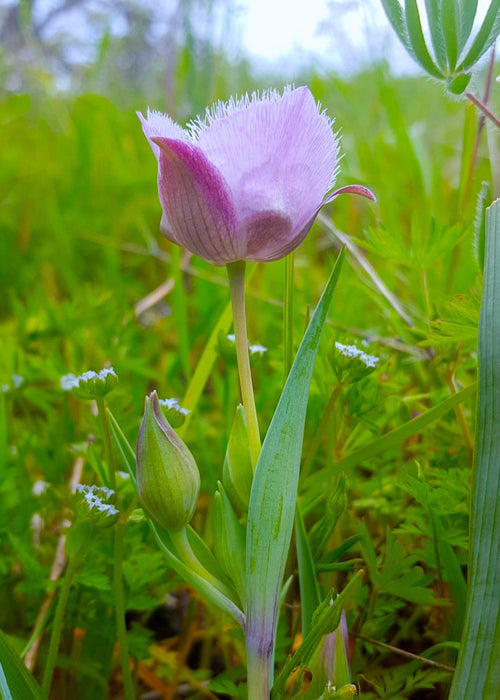
tulip flower tulip seeds Tolemie’s Star Tulip Seeds (Calochortus tolmiei)The flower petals of this native West Coast lily are frequently (and justifiably) compared to the fuzzy ears of cat. They might also be compared to a hazy white purple star nebula, or a tidepool anemone: pale, hazy, deep, and bedazzled in fine, soft, short filaments. There are few other plants outside of this interesting genus that look so singularly unique. Tolemies star tulip is native from western British Columbia south into California, occurring
The flower petals of this native West Coast lily are frequently (and justifiably) compared to the fuzzy ears of cat. They might also be compared to a hazy white-purple star nebula, or a tidepool anemone: pale, hazy, deep, and bedazzled in fine, soft, short filaments. There are few other plants outside of this interesting genus that look so singularly unique.
Tolemie’s star tulip is native from western British Columbia south into California, occurring in and around rocky outcrops, open slopes, and the messy, grassy understories of semi-open oak woodlands. The spring to early summer blooms are cream to white to pale blue-lavender in color, usually with a deeper, dark colored center, rising on stems up to about 12-inches in height from exceptionally long-lived, edible bulbs.
The flowers are bee-visited, notably by the blue-and-black mining bee (Andrena nigrocaerulea), regionally widespread bumble bees, such as the yellow-faced bumble bee (Bombus vosnesenskii), and the dense-haired mason bee (Osmia densa).
Tolemie’s star tulip is great for spots with at least 50% daily sun, and good drainage (especially summer drainage). Put it to use in the restoration of rocky prairies, rock gardens, and alpine-inspired plantings on thin soils. (It's also possibly an interesting specimen plant for some green roof applications). Plants emerge in spring but are dormant and die back to the ground over the summer.
Like other native geophytes (bulb-forming plants), this species is best established via fall seeding. We recommend using deep containers and a sandy loam seed-starting mix. Seeds should be only shallowly covered with a thin layer of top-dressing sand, with the containers left outside over the winter and exposed to the elements. (Note screen coverings are useful to prevent bird/squirrel vandalism to seedling trays). Germination usually occurs the first spring after overwintering, occurring as a single small grass-like blade that disappears after a few short weeks. Young plants should be maintained in protective container propagation for several years. This short spring season foliage appearance repeats itself over several years as the plant slowly matures. Don’t expect flowers for at least 5 to 10 years. By the time 3 or 4 stems are emerging in the spring from containers, the plant is large enough for transplanting into the ground. Protect from larger competitive growth for the first few years. Short, fine-leaved native grasses are good companions for this plant. A lot of work goes into the stewardship of Calochortus – think of them as future grandchildren. Their life journeys will far surpass our own.
Mature bulbs can be periodically dug, separating small bulbils to clonally propagate new plants.
Approximately 25 seeds (0.05 grams).
Shipping Notes
- Free Standard Shipping on $100+ Orders to the USA.
- Except Preorder products are shipped in 48 hours.
- Delivery to the USA:
- Standard Shipping : 3-10 business days
- If time is of the essence, please consider selecting expedited delivery for faster service.
Exchange/Return Notes
- We offer a 30-day return/exchange service after receiving.
- Final sale items are not eligible for returns or exchanges.
- To process your return/exchange, please contact us at [email protected]
- Please click here for more details>>> Return & Exchange Policy